Subtitles available in English, Spanish, Brazilian Portuguese
TL;DR
Synonym Agent in Synerise AI Hub analyzes real user search behavior on a given index. It uses LLM to generate synonym pair suggestions, each with a confidence score and a reason. Every suggestion lands in a review panel where reviewers accept, edit, or reject it before going live, so search relevance stays under team control. The agent runs on a configurable weekly or monthly cycle, with an optional cold-start mode for new indexes. Currently available in public preview.
What words are customers using that your search index doesn't yet recognize?
More than you'd think. We've introduced Synonym Agent in Synerise AI Hub, where it runs on the same behavioral AI infrastructure as your on-site search and Shopping Assistant. Available now in public preview, enabled per workspace via your CSI manager or a Service Desk request.
What this shifts in practice
- Your synonyms keep up with how customers actually search, not just what the team imagined. The Agent reads the search behavior, picking up cases where customers try one search, then quickly try a related one. Those pairings end up in the review queue as synonym candidates, instead of slipping past as failed searches.
- Search-relevance work becomes a review job, not an authoring job. Reviewers accept, edit, or reject pre-generated suggestions, each with a confidence score and a reason attached. The work stops being "what should I add" and becomes "yes, edit, no."
- Search relevance stays under team oversight. Every change is something a person chooses to ship. Each AI proposal sits in the 'Suggested' view until a reviewer decides. 'Accepted' suggestions become active in the index, and 'Rejected' ones are kept for reference.
- A synonym accepted once works wherever your search runs. On-site search and Shopping Assistant both query the same index, Synonym Agent updates. One acceptance lifts results everywhere.
Key capabilities
Suggestion generation, on a cycle you set
Generation runs on one of two cycles:
- Weekly — trains faster, with lower confidence per suggestion.
- Monthly — runs every 30 days, uses more behavioral data per run, and produces higher-confidence suggestions.
For new or empty indexes with no search history, an optional one-time cold-start generates an initial batch from product catalog data. Cold start cannot be re-run for the same index, even after disabling and re-enabling the Agent.
One-way and two-way synonyms
Synonym Agent proposes synonyms in both directions, and the difference shapes how each rule behaves at search time:
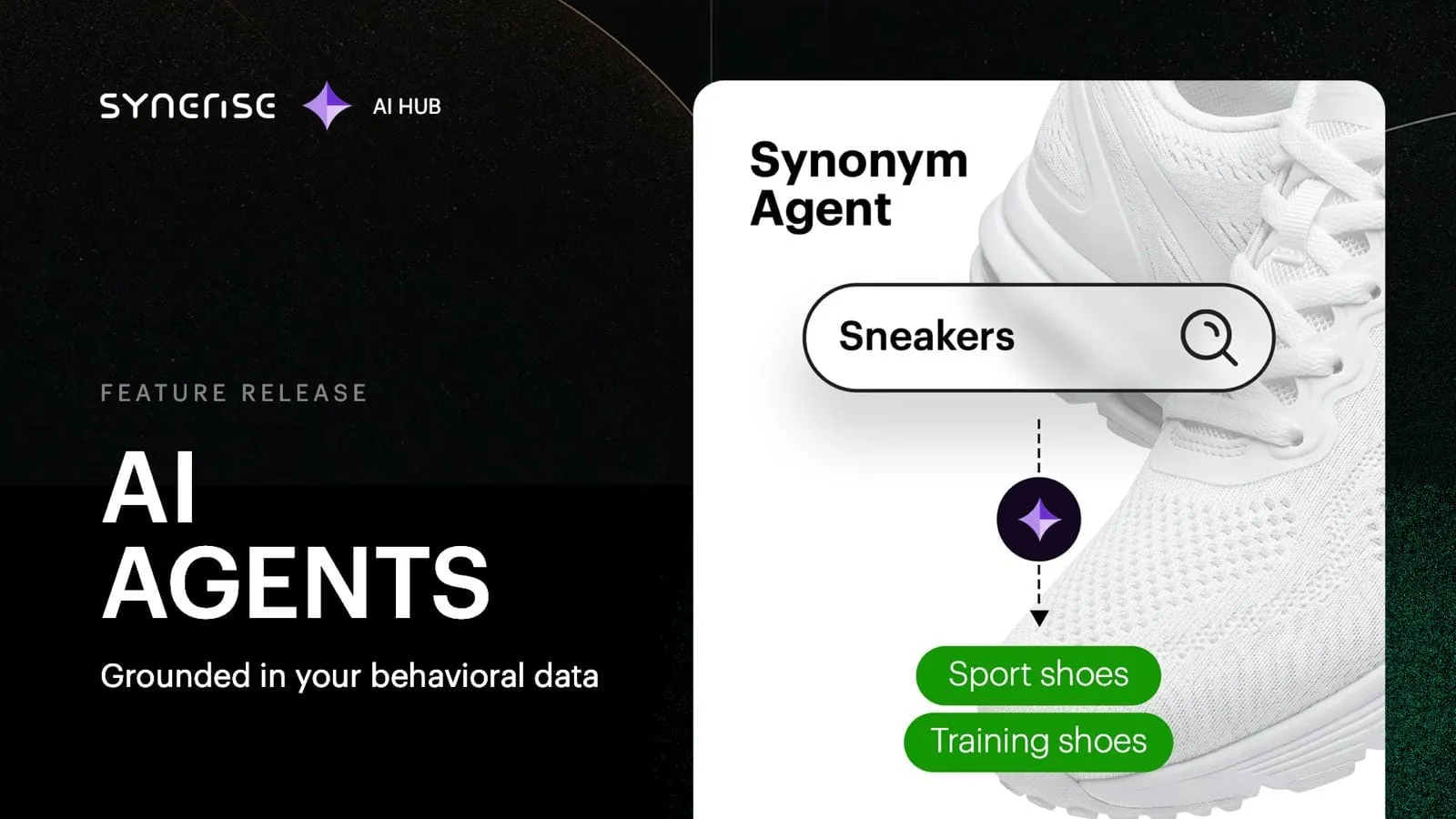
- One-way routes a customer term to a catalog term without going the other way. "Sneakers" returns running shoes; "running shoes" doesn't return sneakers. Useful when customer language is broader or more colloquial than your catalog and you don't want the reverse: "fridge" → "refrigerator", "PJ" → "pajamas", brand misspellings → correct brand names.
- Two-way treats terms as fully interchangeable. "Couch" and "sofa" return the same results in either direction. Common for regional variants ("trainers" / "sneakers" in UK / US), stylistic ones ("jumper" / "sweater"), or any pair where both terms genuinely mean the same thing.
The direction is visible in both the suggestion list and the active synonyms table.
Confidence score and reason for every suggestion
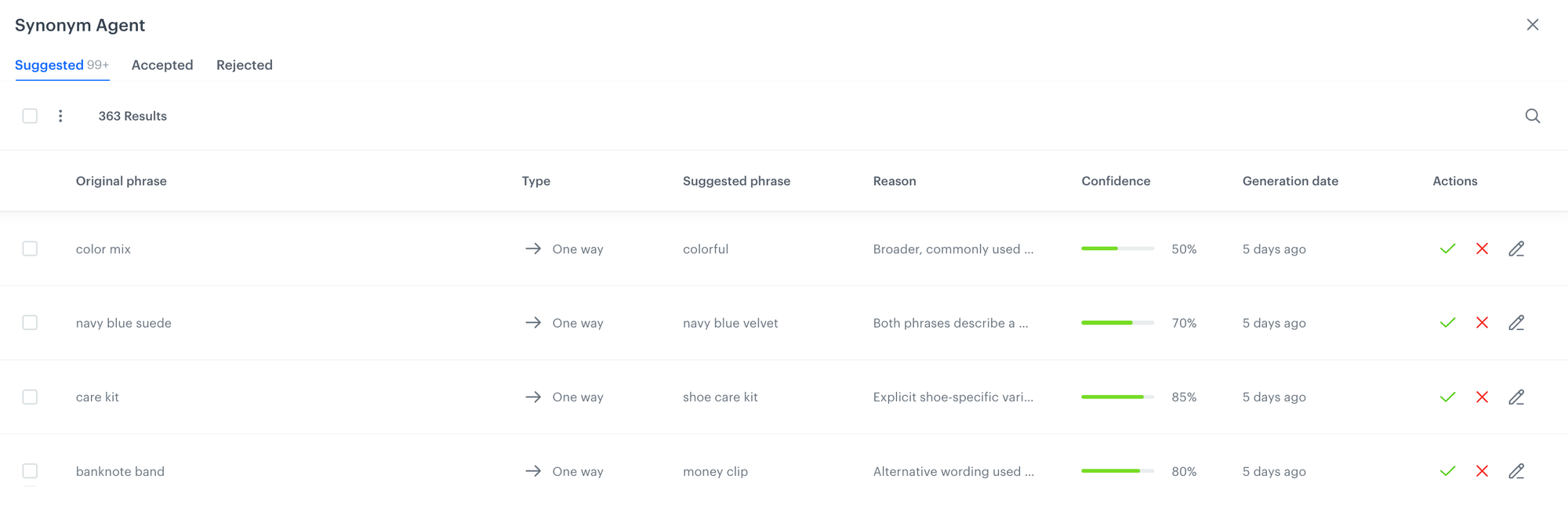
Every suggestion has a confidence score plus a reason that explains what triggered it. Reviewers can start with the high-confidence ones.
Review and decision

AI proposals arrive in a 'Suggested' view inside the 'Review suggestions' pop-up. Each one can be accepted, rejected, or edited and then accepted. All three actions are irreversible. Once acted on, suggestions become visible in the main synonyms list.
For each suggestion, the reviewer sees the original phrase, the suggested phrase, the synonym type, the reason, the confidence score, and the generation date.
What to know before enabling
- Accuracy. AI-generated suggestions can be wrong. The review workflow exists for that reason.
- Data prerequisite. The agent runs on
item.searchevent history (specifically withsearchType=full-text-search). Indexes without that history can still use the one-time cold-start option, which draws from product catalog data instead.
Authors
We’ve been running the Synonym Agent on our own setup, and the honest takeaway is this: the cycle of “discover synonyms → review → re-run → review again” gets a lot shorter. The agent learns your catalog, your customers’ phrasing, the small linguistic habits that make your business yours. Getting a search index right is never really “done” — it’s something you nurture. This feature makes nurturing it a lot less hands-on. Michał Pastuszak (Head of Product)
Release note contributors: Małgorzata Wojtowicz (Product Marketing Manager), Aleksandra Wyszkowska (Product Evangelist), Michał Pastuszak (Head of Product)
Try Synonym Agent in public preview
Synonym Agent is in public preview. Contact your Synerise CSI manager, or request access directly:
FAQ
Will Synonym Agent change synonyms my team has already created?
No. Manually authored synonyms and imported synonyms stay as they are, and the 'Adding source' column in the main view (Manual, CSV import, AI agents) makes the origin of every entry visible. Synonym Agent adds proposals to a separate suggestions view.
What's the difference between weekly and monthly generation?
Weekly trains faster, with lower confidence per suggestion. Monthly runs every 30 days, uses more behavioral data per run, and produces higher-confidence suggestions. The choice is between speed of learning and confidence per proposal.
Why does each suggestion need a human to accept it?
Search relevance has direct business consequences, and synonyms can shift what customers see. AI-generated suggestions can be wrong, which is why every proposal arrives in a 'Suggested' queue with a confidence score and a reason attached. Reviewers decide quickly without auditing every entry from scratch, and relevance stays under explicit team oversight.
Can the synonyms the Synonym Agent generates be read by other AI surfaces?
Accepted synonyms live in the active search index. Any surface that queries that index reads the same relevance layer, which means synonym work done once isn't isolated to a single surface. Synonym Agent is one agent in the Synerise Agent family, and the index it works on is shared with other agents that read from the same source.
Key facts
| Attribute | Value |
|---|---|
| Feature | Synonym Agent |
| Module | Synerise AI Hub (AI Search index configuration) |
| Type | AI Agent (Synerise Agent family) |
| Availability | Public Preview. Enable per workspace via Synerise CSI manager or Service Desk |
| Purpose | Generate synonym suggestions for a search index based on user search behavior |
| Synonym types | One-way, two-way |
| Generation frequency | Weekly (faster, lower confidence) or Monthly (every 30 days, higher confidence) |
| Cold start | Optional one-time generation for indexes without search history; uses product catalog data; cannot be re-run for the same index |
| Data requirement | item.search event history with searchType=full-text-search for regular cycles |
| Confidence scoring | Yes. Percentage score and textual reason per suggestion |
| Activation flow | Suggestions appear in a Suggested view; each must be accepted, edited, or rejected before going live (actions are irreversible) |