Feature Overview
Predictive Filtering is an AI feature in Synerise AI Search that uses a predictive model to automatically assign the most relevant category to each search query. Instead of relying on manually configured query rules, the model narrows search results based on behavioral data and patterns — significantly reducing complexity while improving search relevance.
The feature is available in the Synerise AI Search module under index settings.
What Is Predictive Filtering?
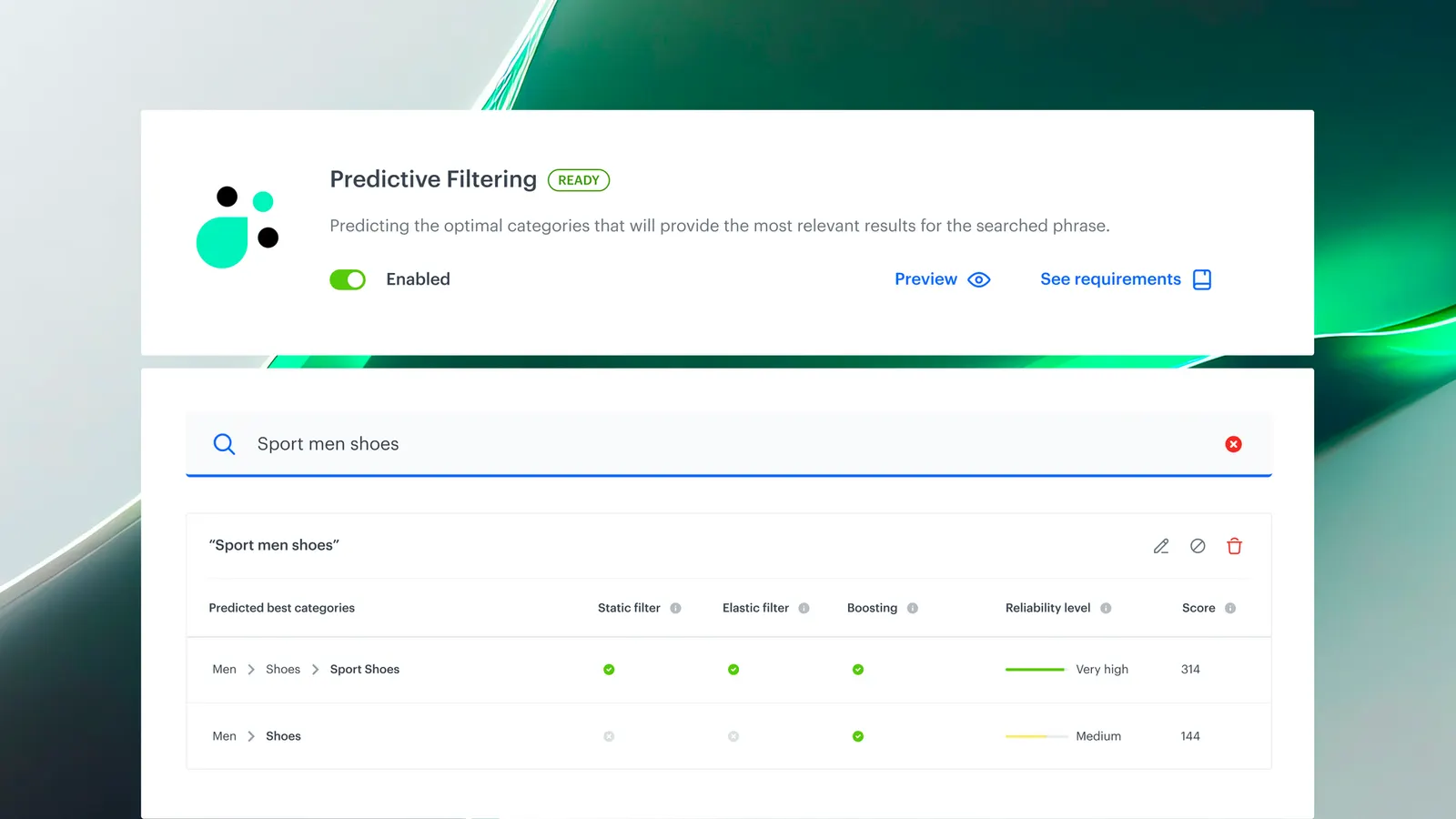
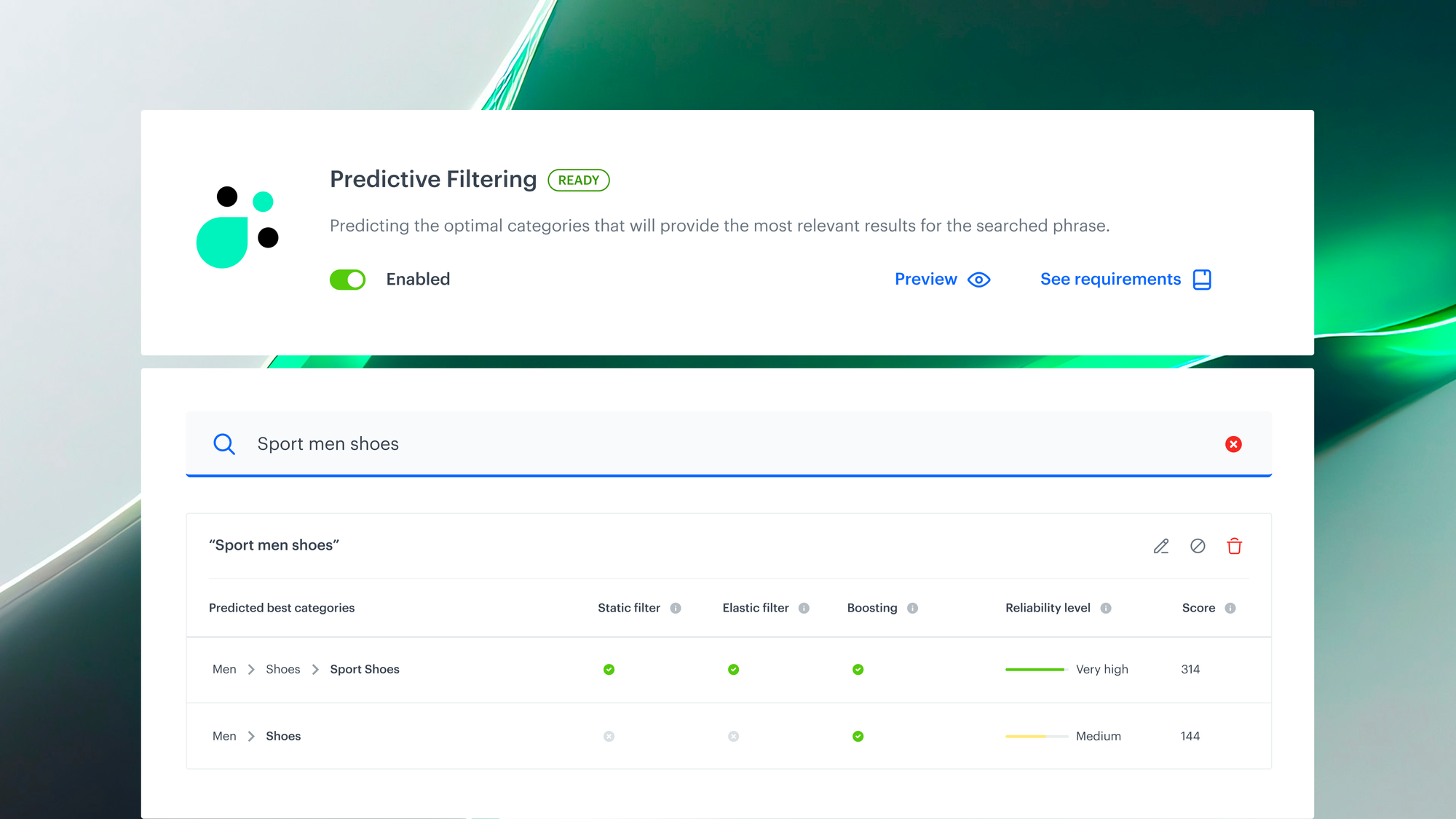
Predictive Filtering is a Synerise AI model that evaluates each search query in context and predicts the most relevant category to filter results. For example, when a user types "shoes", the model can automatically narrow results to "sports shoes" based on historical search behavior, click data, and indexing structure. Each prediction includes a reliability level (low, medium, high), and users can adjust predictions, exclude specific phrases or categories, and preview live effects.
Why Predictive Filtering Matters
In large product catalogs with many overlapping or ambiguous terms, manually configuring category-matching rules for each search term is complex, time-consuming, and difficult to maintain. Without automation, search results include noise from irrelevant categories, reducing precision and conversion.
Predictive Filtering addresses this by:
- Automatically predicting the most relevant category for each query — reducing the need for manual query rules
- Using real-world user behavior (search history, click data) to improve precision
- Providing reliability levels and manual override options for fine-tuning
- Supporting both stricter logic for static filters and looser thresholds for flexible filters
Key Capabilities
AI-powered category prediction
The model evaluates each search query in context and assigns the most relevant category using historical search behavior, click data, and indexing structure. Predictions are calculated on the fly for each query.
Reliability levels
Each prediction includes a reliability indicator (low, medium, high), helping users understand the confidence level of the automated category assignment.
Manual overrides and exclusions
Users can adjust predictions, exclude specific phrases or categories, and preview the live effects of changes before applying them.
Adaptive filter logic
The model adapts based on filter type — applying stricter logic for static filters and looser thresholds for flexible filters, making it effective across different catalog structures.
How Predictive Filtering Works
- Navigate to AI Search > Index Settings > Predictive Filtering in Synerise.
- Enable Predictive Filtering for the search index.
- The model begins evaluating search queries and assigning category predictions based on behavioral data.
- Review predictions with their reliability levels in the configuration panel.
- Optionally adjust predictions, exclude phrases or categories, and preview live effects.
- Predictions are applied automatically to search results, narrowing results to the most relevant category.
Example Use Case
A fashion e-commerce store has a large catalog with overlapping product categories. Without Predictive Filtering, searching for "jacket" returns results from outdoor jackets, suit jackets, and jacket potatoes (a food item incorrectly categorized). With Predictive Filtering enabled, the model uses behavioral data showing that 85% of users searching "jacket" click on outerwear products — and automatically filters results to the "Outerwear" category with high reliability. The merchandising team no longer needs to maintain manual query rules for hundreds of ambiguous terms.
FAQ
What is Predictive Filtering?
An AI feature in Synerise AI Search that automatically assigns the most relevant category to each search query based on behavioral data, reducing the need for manual query rules.
What are reliability levels?
Each prediction is accompanied by a reliability indicator (low, medium, high) showing the confidence level of the category assignment.
Can I override predictions?
Yes. Predictions can be adjusted, and specific phrases or categories can be excluded. Live preview is available.
Does it work with large catalogs?
Yes. Predictive Filtering is especially effective in large catalogs with many overlapping or ambiguous terms.
Key Facts
| Attribute | Value |
|---|---|
| Feature | Predictive Filtering |
| Product | Synerise |
| Module | AI Search |
| Purpose | Automatically predict and apply the most relevant category filter for each search query |
| Model input | Historical search behavior, click data, indexing structure |
| Reliability levels | Low, medium, high |
| Manual overrides | Adjust predictions, exclude phrases/categories, live preview |
| Documentation | hub.synerise.com — Predictive Filtering |
Related Concepts
- Synerise AI Search
- Search relevance and category filtering
- Query rule management
- Behavioral data in search optimization
- Query suggestions statistics
TL;DR
Predictive Filtering in Synerise AI Search uses a predictive model to automatically assign the most relevant category to each search query, based on behavioral data (search history, click data). Each prediction includes a reliability level, and users can override or exclude predictions with live preview. The feature reduces manual query rule complexity while improving search relevance, especially in large catalogs.