Feature Overview
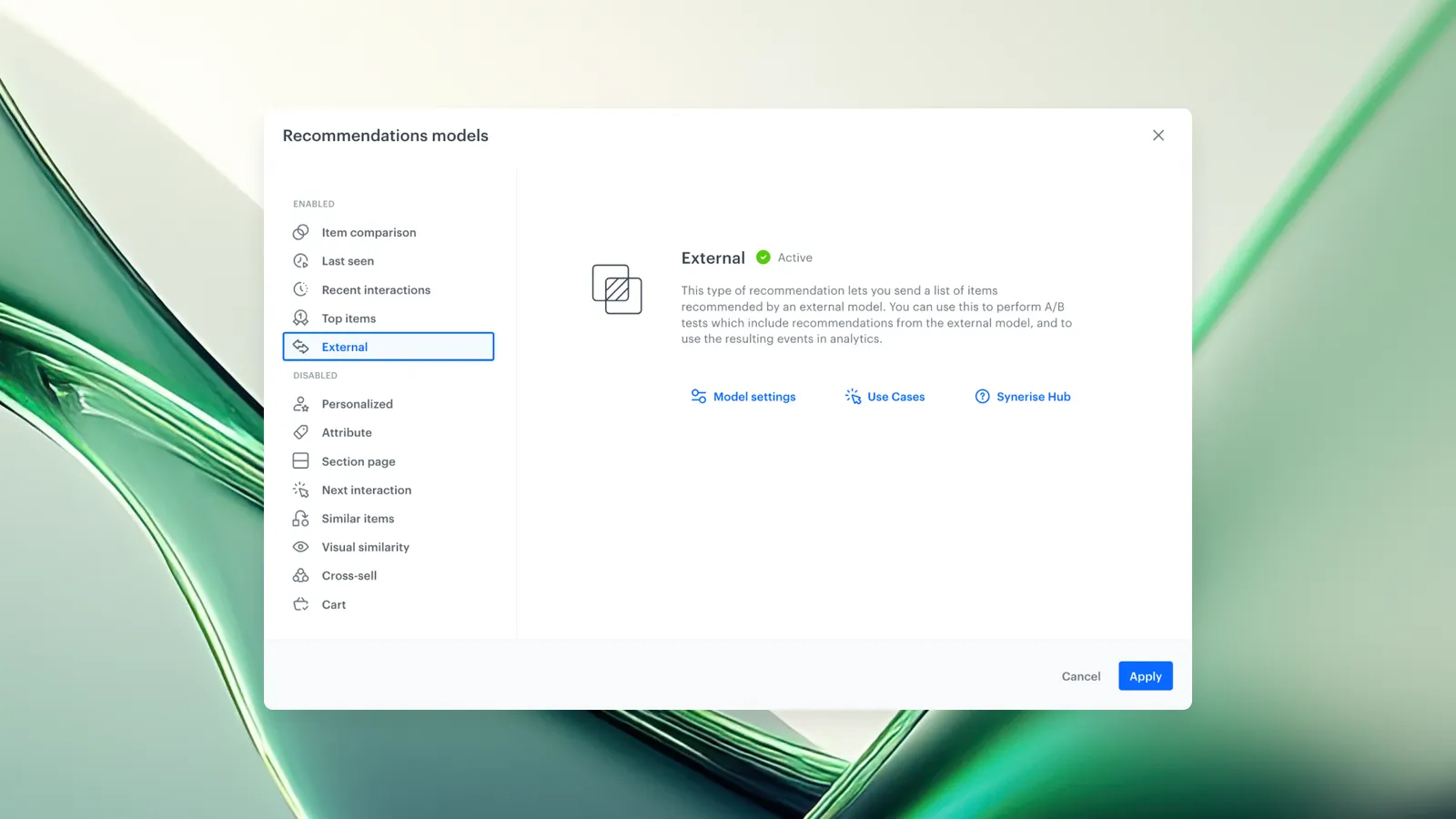
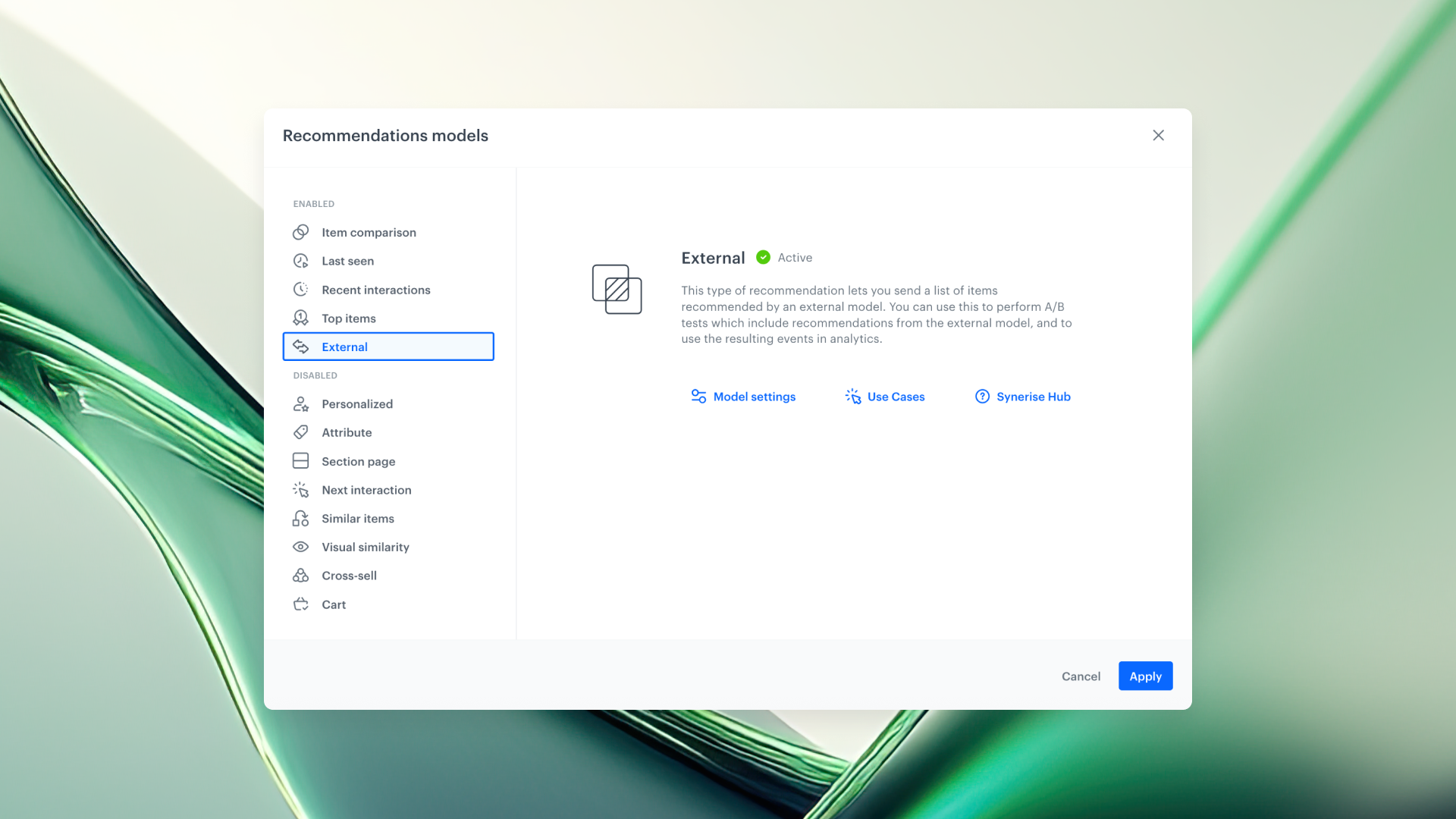
External Recommendation Models is a capability in Synerise Recommendations that allows users to include recommendations generated by external systems — such as custom ML engines, LLM-based models, or third-party tools — in A/B/X tests alongside native Synerise recommendation models. The external model variant accepts explicitly provided item IDs and generates standard recommendation events, enabling unified performance comparison within the Synerise analytics framework.
The feature is available through the "External" recommendation type in the Synerise Recommendations module and is designed for A/B/X testing workflows.
What Are External Recommendation Models?
External Recommendation Models is a recommendation type in Synerise that lets users declare item IDs recommended by an external system and have Synerise generate recommendation events as if the items were recommended by a native model. The recommended items must exist in the item feed. Because the items are explicitly provided in the request, the recommendation context has no influence on them — the customer context is only needed to assign the event to a profile.
This recommendation type can be included as a variant in A/B/X tests, allowing direct comparison of external model performance against native Synerise models using the same tracking and analytics infrastructure.
Why External Recommendation Models Matter
Without this feature, comparing external recommendation models against Synerise models requires separate testing infrastructure, manual result collection, and custom analytics. This makes it difficult to evaluate whether an external model outperforms native models under identical conditions.
External Recommendation Models address this by:
- Allowing external recommendation systems to participate in Synerise A/B/X tests as standard variants
- Generating the same recommendation events as native models, ensuring consistent tracking and analytics
- Eliminating the need for separate testing infrastructure or manual performance comparison
- Supporting validation of LLM-based suggestions, custom ML engines, or third-party recommendation tools within existing optimization workflows
Key Capabilities
External recommendation variant in A/B/X tests
A/B/X tests now support an "External" variant type. When this variant is active, item IDs are passed directly in the recommendation request (via externalItemId or recommendedItemsFromExternalModel), and Synerise generates standard recommendation events for tracking and comparison.
Unified event generation and analytics
Recommendations from external models generate the same events as native Synerise models. This means all variants in an A/B/X test — both native and external — are tracked, measured, and compared using the same analytics framework.
Graceful handling of missing item IDs
If item IDs are not provided when the external variant is active, no recommendation is returned and no event is generated. Resending the request with valid item IDs logs the recommendation as usual — no error state is created.
How External Recommendation Models Work
- Create a recommendation campaign in Synerise and set the type to "External".
- Include this recommendation as a variant in an A/B/X test.
- When the external variant is active, pass the recommended item IDs directly in the request.
- Synerise generates standard recommendation events for the external variant.
- Track and compare performance of all variants — native and external — within Synerise analytics.
Example Use Case
An e-commerce company has developed a custom ML model for product recommendations and wants to compare its performance against the native Synerise recommendation engine. Using External Recommendation Models, they create an A/B/X test with three variants: the Synerise model, the custom ML model (external), and a bestseller fallback. When the external variant is active, the custom model's recommended item IDs are passed in the request. All three variants generate the same event types, allowing direct performance comparison in Synerise analytics — no separate testing infrastructure required.
FAQ
What are External Recommendation Models in Synerise?
External Recommendation Models allow you to include recommendations from external systems (custom ML engines, LLM-based models, third-party tools) as variants in Synerise A/B/X tests, with unified event generation and analytics.
Do external recommendations generate the same events as native models?
Yes. External recommendations generate standard Synerise recommendation events, ensuring consistent tracking and comparison across all A/B/X test variants.
What happens if item IDs are not provided for an external variant?
No recommendation is returned and no event is generated. Resending the request with valid item IDs logs the recommendation normally.
Do recommended items need to exist in the item feed?
Yes. All item IDs provided for external recommendations must exist in the Synerise item feed.
Key Facts
| Attribute | Value |
|---|---|
| Feature | External Recommendation Models |
| Product | Synerise |
| Module | Recommendations (A/B/X Testing) |
| Purpose | Include external recommendation systems in A/B/X tests with unified event generation and analytics |
| Input | Item IDs provided via externalItemId or recommendedItemsFromExternalModel |
| Event generation | Standard Synerise recommendation events |
| Item feed required | Yes — items must exist in the feed |
| Documentation | hub.synerise.com — A/B/X Test with External Model |
Related Concepts
- Synerise Recommendations module
- A/B/X testing in Synerise
- Recommendation event tracking
- Custom ML model integration
- Item feed management
TL;DR
External Recommendation Models in Synerise allow recommendations from external systems — custom ML engines, LLM-based models, or third-party tools — to participate in A/B/X tests as standard variants. External recommendations generate the same events as native Synerise models, enabling direct performance comparison within unified analytics. Item IDs are provided explicitly in the request, and all items must exist in the Synerise item feed.